AI Essay Body

AI Essay Body — independent reviews, comparisons, pricing and step-by-step guides on Aizhi.

  • Embodied cognitive science

    Embodied cognitive science

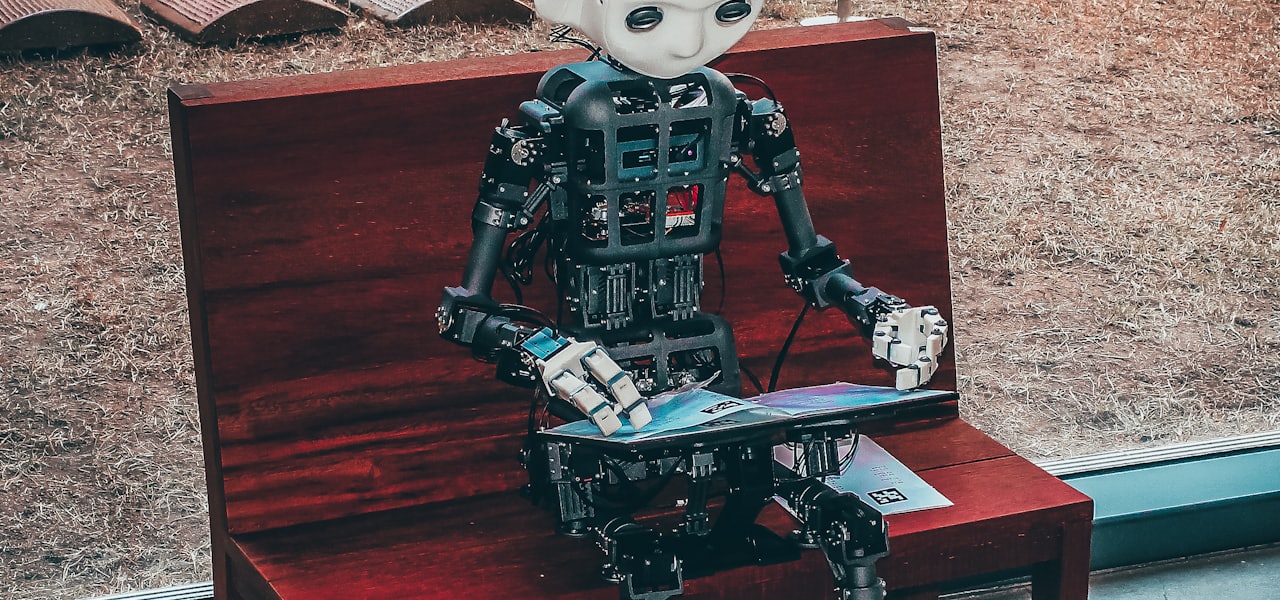
    Embodied cognitive science is an interdisciplinary field of research, the aim of which is to explain the mechanisms underlying intelligent behavior. It comprises three main methodologies: the modeling of psychological and biological systems in a holistic manner that considers the mind and body as a single entity; the formation of a common set of general principles of intelligent behavior; and the experimental use of robotic agents in controlled environments. == Contributors == Embodied cognitive science borrows heavily from embodied philosophy and the related research fields of cognitive science, psychology, neuroscience and artificial intelligence. Contributors to the field include: From the perspective of neuroscience, Gerald Edelman of the Neurosciences Institute at La Jolla, Francisco Varela of CNRS in France, and J. A. Scott Kelso of Florida Atlantic University From the perspective of psychology, Lawrence Barsalou, Michael Turvey, Vittorio Guidano and Eleanor Rosch From the perspective of linguistics, Gilles Fauconnier, George Lakoff, Mark Johnson, Leonard Talmy and Mark Turner From the perspective of language acquisition, Eric Lenneberg and Philip Rubin at Haskins Laboratories From the perspective of anthropology, Edwin Hutchins, Bradd Shore, James Wertsch and Merlin Donald. From the perspective of autonomous agent design, early work is sometimes attributed to Rodney Brooks or Valentino Braitenberg From the perspective of artificial intelligence, Understanding Intelligence by Rolf Pfeifer and Christian Scheier or How the Body Shapes the Way We Think, by Rolf Pfeifer and Josh C. Bongard From the perspective of philosophy, Andy Clark, Dan Zahavi, Shaun Gallagher, and Evan Thompson In 1950, Alan Turing proposed that a machine may need a human-like body to think and speak: It can also be maintained that it is best to provide the machine with the best sense organs that money can buy, and then teach it to understand and speak English. That process could follow the normal teaching of a child. Things would be pointed out and named, etc. Again, I do not know what the right answer is, but I think both approaches should be tried. == Traditional cognitive theory == Embodied cognitive science is an alternative theory to cognition in which it minimizes appeals to computational theory of mind in favor of greater emphasis on how an organism's body determines how and what it thinks. Traditional cognitive theory is based mainly around symbol manipulation, in which certain inputs are fed into a processing unit that produces an output. These inputs follow certain rules of syntax, from which the processing unit finds semantic meaning. Thus, an appropriate output is produced. For example, a human's sensory organs are its input devices, and the stimuli obtained from the external environment are fed into the nervous system which serves as the processing unit. From here, the nervous system is able to read the sensory information because it follows a syntactic structure, thus an output is created. This output then creates bodily motions and brings forth behavior and cognition. Of particular note is that cognition is sealed away in the brain, meaning that mental cognition is cut off from the external world and is only possible by the input of sensory information. == The embodied cognitive approach == Embodied cognitive science differs from the traditionalist approach in that it denies the input-output system. This is chiefly due to the problems presented by the Homunculus argument, which concluded that semantic meaning could not be derived from symbols without some kind of inner interpretation. If some little man in a person's head interpreted incoming symbols, then who would interpret the little man's inputs? Because of the specter of an infinite regress, the traditionalist model began to seem less plausible. Thus, embodied cognitive science aims to avoid this problem by defining cognition in three ways. === Physical attributes of the body === The first aspect of embodied cognition examines the role of the physical body, particularly how its properties affect its ability to think. This part attempts to overcome the symbol manipulation component that is a feature of the traditionalist model. Depth perception, for instance, can be better explained under the embodied approach due to the sheer complexity of the action. Depth perception requires that the brain detect the disparate retinal images obtained by the distance of the two eyes. In addition, body and head cues complicate this further. When the head is turned in a given direction, objects in the foreground will appear to move against objects in the background. From this, it is said that some kind of visual processing is occurring without the need of any kind of symbol manipulation. This is because the objects appearing to move the foreground are simply appearing to move. This observation concludes then that depth can be perceived with no intermediate symbol manipulation necessary. A more poignant example exists through examining auditory perception. Generally speaking the greater the distance between the ears, the greater the possible auditory acuity. Also relevant is the amount of density in between the ears, for the strength of the frequency wave alters as it passes through a given medium. The brain's auditory system takes these factors into account as it process information, but again without any need for a symbolic manipulation system. This is because the distance between the ears for example does not need symbols to represent it. The distance itself creates the necessary opportunity for greater auditory acuity. The amount of density between the ears is similar, in that it is the actual amount itself that simply forms the opportunity for frequency alteration. Thus under consideration of the physical properties of the body, a symbolic system is unnecessary and an unhelpful metaphor. === The body's role in the cognitive process === The second aspect draws heavily from George Lakoff's and Mark Johnson's work on concepts. They argued that humans use metaphors whenever possible to better explain their external world. Humans also have a basic stock of concepts in which other concepts can be derived from. These basic concepts include spatial orientations such as up, down, front, and back. Humans can understand what these concepts mean because they can directly experience them from their own bodies. For example, because human movement revolves around standing erect and moving the body in an up-down motion, humans innately have these concepts of up and down. Lakoff and Johnson contend this is similar with other spatial orientations such as front and back too. As mentioned earlier, these basic stocks of spatial concepts are the basis in which other concepts are constructed. Happy and sad for instance are seen now as being up or down respectively. When someone says they are feeling down, what they are really saying is that they feel sad for example. Thus the point here is that true understanding of these concepts is contingent on whether one can have an understanding of the human body. So the argument goes that if one lacked a human body, they could not possibly know what up or down could mean, or how it could relate to emotional states. [I]magine a spherical being living outside of any gravitational field, with no knowledge or imagination of any other kind of experience. What could UP possibly mean to such a being? While this does not mean that such beings would be incapable of expressing emotions in other words, it does mean that they would express emotions differently from humans. Human concepts of happiness and sadness would be different because human would have different bodies. So then an organism's body directly affects how it can think, because it uses metaphors related to its body as the basis of concepts. === Interaction of local environment === A third component of the embodied approach looks at how agents use their immediate environment in cognitive processing. Meaning, the local environment is seen as an actual extension of the body's cognitive process. The example of a personal digital assistant (PDA) is used to better imagine this. Echoing functionalism (philosophy of mind), this point claims that mental states are individuated by their role in a much larger system. So under this premise, the information on a PDA is similar to the information stored in the brain. So then if one thinks information in the brain constitutes mental states, then it must follow that information in the PDA is a cognitive state too. Consider also the role of pen and paper in a complex multiplication problem. The pen and paper are so involved in the cognitive process of solving the problem that it seems ridiculous to say they are somehow different from the process, in very much the same way the PDA is used for information like the brain. Another example examines how humans control and manipulate their environment

    Read more →
  • Web API

    Web API

    A web API is an application programming interface (API) for either a web server or a web browser. As a web development concept, it can be related to a web application's client side (including any web frameworks being used). A server-side web API consists of one or more publicly exposed endpoints to a defined request–response message system, typically expressed in JSON or XML by means of an HTTP-based web server. A server API (SAPI) is not considered a server-side web API, unless it is publicly accessible by a remote web application. == Client side == A client-side web API is a programmatic interface to extend functionality within a web browser or other HTTP client. Originally these were most commonly in the form of native plug-in browser extensions however most newer ones target standardized JavaScript bindings. The Mozilla Foundation created their WebAPI specification which is designed to help replace native mobile applications with HTML5 applications. Google created their Native Client architecture which is designed to help replace insecure native plug-ins with secure native sandboxed extensions and applications. They have also made this portable by employing a modified LLVM AOT compiler. == Server side == A server-side web API consists of one or more publicly exposed endpoints to a defined request–response message system, typically expressed in JSON or XML. The web API is exposed most commonly by means of an HTTP-based web server. Mashups are web applications which combine the use of multiple server-side web APIs. Webhooks are server-side web APIs that take input as a Uniform Resource Identifier (URI) that is designed to be used like a remote named pipe or a type of callback such that the server acts as a client to dereference the provided URI and trigger an event on another server which handles this event thus providing a type of peer-to-peer IPC. === Endpoints === Endpoints are important aspects of interacting with server-side web APIs, as they specify where resources can be accessed by third-party software. Usually the access is via a URI to which HTTP requests are posted, and from which the response is thus expected. Web APIs may be public or private, the latter of which requires an access token. Endpoints need to be static, otherwise the correct functioning of software that interacts with them cannot be guaranteed. If the location of a resource changes (and with it the endpoint) then previously written software will break, as the required resource can no longer be found at the same place. As API providers still want to update their web APIs, many have introduced a versioning system in the URI that points to an endpoint. === Resources versus services === Web 2.0 Web APIs often use machine-based interactions such as REST and SOAP. RESTful web APIs use HTTP methods to access resources via URL-encoded parameters, and use JSON or XML to transmit data. By contrast, SOAP protocols are standardized by the W3C and mandate the use of XML as the payload format, typically over HTTP. Furthermore, SOAP-based Web APIs use XML validation to ensure structural message integrity, by leveraging the XML schemas provisioned with WSDL documents. A WSDL document accurately defines the XML messages and transport bindings of a Web service. === Documentation === Server-side web APIs are interfaces for the outside world to interact with the business logic. For many companies this internal business logic and the intellectual property associated with it are what distinguishes them from other companies, and potentially what gives them a competitive edge. They do not want this information to be exposed. However, in order to provide a web API of high quality, there needs to be a sufficient level of documentation. One API provider that not only provides documentation, but also links to it in its error messages is Twilio. However, there are now directories of popular documented server-side web APIs. === Growth and impact === The number of available web APIs has grown consistently over the past years, as businesses realize the growth opportunities associated with running an open platform, that any developer can interact with. ProgrammableWeb tracks over 24000 Web APIs that were available in 2022, up from 105 in 2005. Web APIs have become ubiquitous. There are few major software applications/services that do not offer some form of web API. One of the most common forms of interacting with these web APIs is via embedding external resources, such as tweets, Facebook comments, YouTube videos, etc. In fact there are very successful companies, such as Disqus, whose main service is to provide embeddable tools, such as a feature-rich comment system. Any website of the TOP 100 Alexa Internet ranked websites uses APIs and/or provides its own APIs, which is a very distinct indicator for the prodigious scale and impact of web APIs as a whole. As the number of available web APIs has grown, open source tools have been developed to provide more sophisticated search and discovery. APIs.json provides a machine-readable description of an API and its operations, and the related project APIs.io offers a searchable public listing of APIs based on the APIs.json metadata format. === Business === ==== Commercial ==== Many companies and organizations rely heavily on their Web API infrastructure to serve their core business clients. In 2014 Netflix received around 5 billion API requests, most of them within their private API. ==== Governmental ==== Many governments collect a lot of data, and some governments are now opening up access to this data. The interfaces through which this data is typically made accessible are web APIs. Web APIs allow for data, such as "budget, public works, crime, legal, and other agency data" to be accessed by any developer in a convenient manner. == Example == An example of a popular web API is the Astronomy Picture of the Day API operated by the American space agency NASA. It is a server-side API used to retrieve photographs of space or other images of interest to astronomers, and metadata about the images. According to the API documentation, the API has one endpoint: https://api.nasa.gov/planetary/apod The documentation states that this endpoint accepts GET requests. It requires one piece of information from the user, an API key, and accepts several other optional pieces of information. Such pieces of information are known as parameters. The parameters for this API are written in a format known as a query string, which is separated by a question mark character (?) from the endpoint. An ampersand (&) separates the parameters in the query string from each other. Together, the endpoint and the query string form a URL that determines how the API will respond. This URL is also known as a query or an API call. In the below example, two parameters are transmitted (or passed) to the API via the query string. The first is the required API key and the second is an optional parameter — the date of the photograph requested. https://api.nasa.gov/planetary/apod?api_key=DEMO_KEY&date=1996-12-03 Visiting the above URL in a web browser will initiate a GET request, calling the API and showing the user a result, known as a return value or as a return. This API returns JSON, a type of data format intended to be understood by computers, but which is somewhat easy for a human to read as well. In this case, the JSON contains information about a photograph of a white dwarf star: The above API return has been reformatted so that names of JSON data items, known as keys, appear at the start of each line. The last of these keys, named url, indicates a URL which points to a photograph: https://apod.nasa.gov/apod/image/9612/ngc2440_hst2.jpg Following the above URL, a web browser user would see this photo: Although this API can be called by an end user with a web browser (as in this example) it is intended to be called automatically by software or by computer programmers while writing software. JSON is intended to be parsed by a computer program, which would extract the URL of the photograph and the other metadata. The resulting photo could be embedded in a website, automatically sent via text message, or used for any other purpose envisioned by a software developer.

    Read more →
  • CSS box model

    CSS box model

    In web development, the CSS box model refers to how HTML elements are modeled in browser engines and how the dimensions of those HTML elements are derived from CSS properties. It is a fundamental concept for the composition of HTML webpages. The guidelines of the box model are described by web standards World Wide Web Consortium (W3C) specifically the CSS Working Group. For much of the late-1990s and early 2000s there had been non-standard compliant implementations of the box model in mainstream browsers. With the advent of CSS2 in 1998, which introduced the box-sizing property, the problem had mostly been resolved. == Specifics == The Cascading Style Sheets (CSS) specification describes how elements of web pages are displayed by graphical browsers. Section 4 of the CSS1 specification defines a "formatting model" that gives block-level elements—such as p and blockquote—a width and height, and three levels of boxes surrounding it: padding, borders, and margins. While the specification never uses the term "box model" explicitly, the term has become widely used by web developers and web browser vendors. All HTML elements can be considered "boxes", this includes div tag, p tag, or a tag. Each of those boxes has five modifiable dimensions: the height and width describe dimensions of the actual content of the box (text, images, ...) the padding describes the space between this content and the border of the box the border is any kind of line (solid, dotted, dashed...) surrounding the box, if present the margin is the space around the border According to the CSS1 specification, released by W3C in 1996 and revised in 1999, when a width or height is explicitly specified for any block-level element, it should determine only the width or height of the visible element, with the padding, borders, and margins applied afterward. Before CSS3, this box model was known as W3C box model, in CSS3, it is known as the content-box. The total width of a box is therefore margin-left + border-left + padding-left + width + padding-right + border-right + margin-right. Similarly, the total height of a box equals margin-top + border-top + padding-top + height + padding-bottom + border-bottom + margin-bottom. For example, the following CSS code would specify the box dimensions of each block belonging to 'my-class'. Moreover, each such box will have total height 140px and width 240px. CSS3 introduced the Internet Explorer box model to the standard, known referred to as border-box. == History == Before HTML 4 and CSS, very few HTML elements supported both border and padding, so the definition of the width and height of an element was not very contentious. However, it varied depending on the element. The HTML width attribute of a table defined the width of the table including its border. On the other hand, the HTML width attribute of an image defined the width of the image itself (inside any border). The only element to support padding in those early days was the table cell. Width for the cell was defined as "the suggested width for a cell content in pixels excluding the cell padding." In 1996, CSS introduced margin, border and padding for many more elements. It adopted a definition width in relation to content, border, margin and padding similar to that for a table cell. This has since become known as the W3C box model. At the time, very few browser vendors implemented the W3C box model to the letter. The two major browsers at the time, Netscape 4.0 and Internet Explorer 4.0 both defined width and height as the distance from border to border. This has been referred to as the traditional or the Internet Explorer box model. Internet Explorer in "quirks mode" includes the content, padding and borders within a specified width or height; this results in a narrower or shorter rendering of a box than would result following the standard behavior. The Internet Explorer box model behavior was often considered a bug, because of the way in which earlier versions of Internet Explorer handle the box model or sizing of elements in a web page, which differs from the standard way recommended by the W3C for the Cascading Style Sheets language. As of Internet Explorer 6, the browser supports an alternative rendering mode (called the "standards-compliant mode") which solves this discrepancy. However, for backward compatibility reasons, all versions still behave in the usual, non-standard way by default (see quirks mode). Internet Explorer for Mac is not affected by this non-standard behavior. === Workarounds === Internet Explorer versions 6 and onward are not affected by the bug if the page contains certain HTML document type declarations. These versions maintain the buggy behavior when in quirks mode for reasons of backward compatibility. For example, quirks mode is triggered: When the document type declaration is absent or incomplete; When an HTML 3 or earlier document is encountered; When an HTML 4.0 Transitional or Frameset document type declaration is used and a system identifier (URI) is not present; When an SGML comment or other unrecognized content appears before the document type declaration Internet Explorer 6 also uses quirks mode if there is an XML declaration prior to the document type declaration. Various workarounds have been devised to force Internet Explorer versions 5 and earlier to display Web pages using the W3C box model. These workarounds generally exploit unrelated bugs in Internet Explorer's CSS selector processing in order to hide certain rules from the browser. The best known of these workarounds is the "box model hack" developed by Tantek Çelik, a former Microsoft employee who developed this idea while working on Internet Explorer for the Macintosh. It involves specifying a width declaration for Internet Explorer for Windows, and then overriding it with another width declaration for CSS-compliant browsers. This second declaration is hidden from Internet Explorer for Windows by exploiting other bugs in the way that it parses CSS rules. The implementation of these CSS “hacks” has been further complicated by the public release of Internet Explorer 7, which has had some issues fixed, but not others, causing undesired results in pages using these hacks. Box model hacks have proven unreliable because they rely on bugs in browsers' CSS support that may be fixed in later versions. For this reason, some Web developers have instead recommended either avoiding specifying both width and padding for the same element or using conditional comment and/or CSS filters to work around the box model bug in older versions of Internet Explorer. == Support for Internet Explorer's box model == Web designer Doug Bowman has said that the original Internet Explorer box model represents a better, more logical approach. Peter-Paul Koch gives the example of a physical box, whose dimensions always refer to the box itself, including potential padding, but never its content. He says that this box model is more useful for graphic designers, who create designs based on the visible width of boxes rather than the width of their content. Bernie Zimmermann says that the Internet Explorer box model is closer to the definition of cell dimensions and padding used in the HTML table model. The W3C has included a "box-sizing" property in CSS3. When box-sizing: border-box; is specified for an element, any padding or border of the element is drawn inside the specified width and height, "as commonly implemented by legacy HTML user agents". Internet Explorer 8, WebKit browsers such as Apple Safari 5.1+ and Google Chrome, Gecko-based browsers such as Mozilla Firefox 29.0 and later, Opera 7.0 and later, and Konqueror 3.3.2 and later support the CSS3 box-sizing property. Gecko browsers previous than 29.0 support the same functionality using the browser-specific -moz-box-sizing property. border-box is the default box model used in Bootstrap framework.

    Read more →
  • Access-independent services

    Access-independent services

    Access-independent service (AIS) is a service concept in which a service does not depend on guaranteed access network cooperation for service delivery. Telecommunications industry analyst Dean Bubley first used the term in a report on Telco-OTT in February 2012. Traditionally, most telecom company or internet service provider services are access-dependent, because they rely heavily on guaranteed access cooperation on the network the service is delivered over. For instance, traditional IP-based TV service (IPTV) delivered by a telecom company is generally a managed service. This means that IPTV service assumes the IPTV service provider has control over the access network that the IPTV service is delivered over, and network quality of service (QoS) guarantees are available for IPTV service delivery. As a result, the reach of a telecom company's IPTV service is generally restricted by the reach of the telecom company's access network. In contrast, services offered by non-traditional video content delivery service providers such as Netflix, Hulu, and Amazon Video are considered access-independent services. Netflix's video content streaming service, for example, dynamically adapts to network conditions in real-time to strive for the best overall quality of experience (QoE) and does not assume guaranteed cooperation from the underlying IP network, such as QoS. As a result, without considering content rights and different countries' government restrictions, the reach of Netflix's video content streaming service is, in theory, the reach of the Internet. Skype is another example of AIS, because Skype offers an IP-based telephony service over the Internet without depending on IP network cooperation guarantees other than basic IP network connectivity. In the context of telecom service delivery, the concept of access independent services is also commonly described by the term "over-the-top" (OTT) services. OTT service providers such as but not limited to Facebook, WeChat, and Netflix generally do not own or directly manage any wide-area access network to begin with, so they design their services for overall quality of experience, with no assumptions on guaranteed access network cooperation.

    Read more →
  • Engineering Historical Memory

    Engineering Historical Memory

    Engineering Historical Memory (EHM) is an online database in the digital humanities, serving as an open-access research tool for primary historical materials focused on 11th to 15th century Afro-Eurasia. It adopts computational methods to make historical documents machine-understandable. EHM parses traditional artifacts such as historical maps, travel accounts, chronicles and codices into computer-readable formats, and links them to secondary multi-media references, a process referred to as the "automatic narrative generation". This approach generates cultural narratives and facilitates interaction with the historical artifacts, making them accessible to audiences from various backgrounds. == History == EHM was first theorised in 2007 by researcher Andrea Nanetti when he was a visiting scholar at Princeton University, and the preliminary test results were published between 2008 and 2011. In 2013, the EHM research team was set up in Singapore following Nanetti's professorship at Nanyang Technological University (NTU). Two years later, after receiving several Microsoft research grants, EHM went live on Microsoft Azure. In 2018, the College of Humanities, Arts and Social Sciences (CoHASS) at NTU Singapore formed the Digital Humanities Research Cluster, as part of which, EHM has been an ongoing interdisciplinary research project led by Nanetti. Partnering with international educational and cultural institutions such as Ca' Foscari University of Venice, University of Florence, Taylor & Francis Group, Delft University of Technology (TUDelft), and SenticNet, EHM has been supported by over 130 scholars and engineers. == Applications == Primary historical materials on EHM are curated into several categories, including maps, travel accounts, chronicles, codices, sites, archival documents, and paintings, such as the Morosini Codex (listed under Chronicles) and Pope Gregory X's Privilege for the Holy Monastery of St Catherine of Sinai (listed under Archival Documents). EHM has been adopted by cultural organisations as an exhibition and research tool in the digital humanities field. An example is the publication of a digital interactive edition of Fra Mauro's Map of the World on EHM, a collaboration project between NTU Singapore and the Biblioteca Nazionale Marciana of Venice. The digitisation process of the map on EHM involved transcribing and geo-referencing the textual content in the 15th-century map, followed by creating semantic annotations to connect the map's content with related secondary data sources. The e-map was subsequently adopted and launched online by Museo Galileo in March 2022 and incorporated into the virtual exhibition "Venezia and Suzhou: Water Cities along the Silk Roads" (online, September-December 2022). In 2024, the Fra Mauro's Map of the World application on EHM was awarded the Digital Humanities and Multimedia Studies Prize (DHMS) by the Medieval Academy of America. Image-Based Video Search Engine is another experimental project under the EHM scope led by the research teams at Delft University of Technology (TUDelft) and NTU Singapore. This ongoing project aims to improve the efficiency of retrieving targeted objects from audio-visuals. == Awards == In 2021, EHM won the GLAMi Awards (MuseWeb Conference - Galleries, Libraries, Archives, and Museums Innovation awards) in the "Resources for Scholars and Researchers" category. In the same year, EHM was a Falling Walls finalist for Science Breakthrough of the Year in the category Social Sciences and Humanities after nominated by the School of Advanced Study at the University of London. In April 2022, the Italian National Commission for UNESCO has selected and sent the EHM project to the organisers of the "Jikji Memory of the World" Award for final evaluation. In January 2024, the Medieval Academy of America announced its 2024 Digital Humanities and Multimedia Studies Prize (DHMS) goes to the Fra Mauro's Map of the World application on EHM.

    Read more →
  • COVFEFE Act

    COVFEFE Act

    The Communications Over Various Feeds Electronically for Engagement Act (COVFEFE Act), House Bill H.R. 2884, was introduced in the United States House of Representatives on June 12, 2017, during the 115th United States Congress. The bill was intended to amend the Presidential Records Act to preserve Twitter posts and other social media interactions of the President of the United States and require the National Archives to store such items. H.R. 2884 was assigned to the House Oversight and Reform Committee for consideration. While in committee, there were no roll call votes related to the bill. The bill died in committee. U.S. Representative Mike Quigley, Democrat of Illinois, introduced the legislation due to Donald Trump's routine use of Twitter, stating "In order to maintain public trust in government, elected officials must answer for what they do and say; this includes 140-character tweets. If the president is going to take to social media to make sudden public policy proclamations, we must ensure that these statements are documented and preserved for future reference". If enacted, the bill "would bar the prolifically tweeting president from deleting his posts, as he has sometimes done". The COVFEFE Act would have also treated a president's personal social media accounts (e.g., Trump's "@realDonaldTrump" Twitter account) the same as official social media accounts (e.g., the "@POTUS" Twitter account). == Background == The bill title refers to "covfefe", a word in a May 31, 2017 tweet that Trump sent at 12:06 AM EDT, reading "Despite the constant negative press covfefe". This incomplete tweet was liked and retweeted hundreds of thousands of times, making it one of the most popular tweets of 2017, as people speculated on its meaning. The tweet was deleted at 5:48 AM EDT. At 6:09 AM EDT, Trump's account tweeted "Who can figure out the true meaning of 'covfefe' ??? Enjoy!" During the May 31 White House press briefing, Hunter Walker of Yahoo! News asked White House press secretary Sean Spicer about the tweet and if there was any concern about the president sending out incoherent tweets that stay up for hours. Spicer responded, "I think the president and a small group of people know exactly what he meant" and offered no other explanation. This unexpected response spawned additional media attention and criticism for its cryptic meaning, with commentators unsure whether or not Spicer was joking. Callum Borchers of The Washington Post's The Fix noted that the Trump administration deliberately responded in a way that encouraged the media and the public to focus on covfefe instead of other controversies like the Russia investigation, resignation of White House communications director Michael Dubke, or U.S.-Germany relations. == Legal significance of Trump's tweeting == Trump's tweets have been legally significant in the past. White House Press Secretary Sean Spicer stated that Trump's tweets are "considered official statements by the President of the United States". Some of his tweets have contradicted his agenda by undercutting or contradicting statements of public officials as well as the arguments of U.S. Department of Justice attorneys seeking to defend Trump's decisions in court. A federal appellate court cited one of Trump's tweets in upholding a lower court's order blocking Trump's Executive Order 13780 from going into effect in 2017. Courts have been clear that Twitter statements can be used as evidence of intent. Before Trump's "@realDonaldTrump" Twitter account was suspended, he blocked a number of users, preventing them from viewing his tweets or posting public replies. A group associated with Columbia University filed a lawsuit on behalf of blocked users, called Knight First Amendment Institute v. Trump. Plaintiffs successfully argued that @realDonaldTrump reply threads constituted a "designated public forum" akin to a public meeting, and therefore blocking users based on their political viewpoints violated their constitutional right to freedom of speech. The Second Circuit upheld this ruling on July 9, 2019. Regardless of the failure of the bill, Trump's tweets have been archived in accordance with the Presidential and Federal Records Act Amendments of 2014.

    Read more →
  • False answer supervision

    False answer supervision

    False answer supervision (FAS) refers to VoIP fraud where the billed duration for the caller is more than the duration of the actual connection duration. The FAS is usually performed by VoIP wholesalers in their softswitches for randomly selected calls. Adding a small amount of extra billed seconds for many calls results in significant revenue for the VoIP wholesaler. == Implementation of FAS == The FAS fraud can be implemented in a softswitch in many different ways. These include: False billing of party A without calling a party B. Usually a fake ringback tone, loopback audio or voicemail message is played Start of billing before actual answer of party B Extra billing after disconnection of party B == Detection of FAS == The FAS can be detected and blocked in a softswitch. Common methods are: Manual verification of call detail records: listening to voice recordings Identification of FAS types and using algorithms to automatically detect the FAS RTP audio signal processing: detection of voice RTP audio signal processing: detection of silence RTP audio signal processing: detection of ringback tone

    Read more →
  • Kimchi (software)

    Kimchi (software)

    Kimchi is a web management tool to manage Kernel-based Virtual Machine (KVM) infrastructure. Developed with HTML5, Kimchi is developed to intuitively manage KVM guests, create storage pools, manage network interfaces (bridges, VLANs, NAT), and perform other related tasks. The name is an extended acronym for KVM infrastructure management. It is an Apache-licensed project hosted on GitHub, and incubated by oVirt.org.

    Read more →
  • Point-set registration

    Point-set registration

    In computer vision, pattern recognition, and robotics, point-set registration, also known as point-cloud registration or scan matching, is the process of finding a spatial transformation (e.g., scaling, rotation and translation) that aligns two point clouds. The purpose of finding such a transformation includes merging multiple data sets into a globally consistent model (or coordinate frame), and mapping a new measurement to a known data set to identify features or to estimate its pose. Raw 3D point cloud data are typically obtained from Lidars and RGB-D cameras. 3D point clouds can also be generated from computer vision algorithms such as triangulation, bundle adjustment, and more recently, monocular image depth estimation using deep learning. For 2D point set registration used in image processing and feature-based image registration, a point set may be 2D pixel coordinates obtained by feature extraction from an image, for example corner detection. Point cloud registration has extensive applications in autonomous driving, motion estimation and 3D reconstruction, object detection and pose estimation, robotic manipulation, simultaneous localization and mapping (SLAM), panorama stitching, virtual and augmented reality, and medical imaging. As a special case, registration of two point sets that only differ by a 3D rotation (i.e., there is no scaling and translation), is called the Wahba Problem and also related to the orthogonal procrustes problem. == Formulation == The problem may be summarized as follows: Let { M , S } {\displaystyle \lbrace {\mathcal {M}},{\mathcal {S}}\rbrace } be two finite size point sets in a finite-dimensional real vector space R d {\displaystyle \mathbb {R} ^{d}} , which contain M {\displaystyle M} and N {\displaystyle N} points respectively (e.g., d = 3 {\displaystyle d=3} recovers the typical case of when M {\displaystyle {\mathcal {M}}} and S {\displaystyle {\mathcal {S}}} are 3D point sets). The problem is to find a transformation to be applied to the moving "model" point set M {\displaystyle {\mathcal {M}}} such that the difference (typically defined in the sense of point-wise Euclidean distance) between M {\displaystyle {\mathcal {M}}} and the static "scene" set S {\displaystyle {\mathcal {S}}} is minimized. In other words, a mapping from R d {\displaystyle \mathbb {R} ^{d}} to R d {\displaystyle \mathbb {R} ^{d}} is desired which yields the best alignment between the transformed "model" set and the "scene" set. The mapping may consist of a rigid or non-rigid transformation. The transformation model may be written as T {\displaystyle T} , using which the transformed, registered model point set is: The output of a point set registration algorithm is therefore the optimal transformation T ⋆ {\displaystyle T^{\star }} such that M {\displaystyle {\mathcal {M}}} is best aligned to S {\displaystyle {\mathcal {S}}} , according to some defined notion of distance function dist ⁡ ( ⋅ , ⋅ ) {\displaystyle \operatorname {dist} (\cdot ,\cdot )} : where T {\displaystyle {\mathcal {T}}} is used to denote the set of all possible transformations that the optimization tries to search for. The most popular choice of the distance function is to take the square of the Euclidean distance for every pair of points: where ‖ ⋅ ‖ 2 {\displaystyle \|\cdot \|_{2}} denotes the vector 2-norm, s m {\displaystyle s_{m}} is the corresponding point in set S {\displaystyle {\mathcal {S}}} that attains the shortest distance to a given point m {\displaystyle m} in set M {\displaystyle {\mathcal {M}}} after transformation. Minimizing such a function in rigid registration is equivalent to solving a least squares problem. == Types of algorithms == When the correspondences (i.e., s m ↔ m {\displaystyle s_{m}\leftrightarrow m} ) are given before the optimization, for example, using feature matching techniques, then the optimization only needs to estimate the transformation. This type of registration is called correspondence-based registration. On the other hand, if the correspondences are unknown, then the optimization is required to jointly find out the correspondences and transformation together. This type of registration is called simultaneous pose and correspondence registration. === Rigid registration === Given two point sets, rigid registration yields a rigid transformation which maps one point set to the other. A rigid transformation is defined as a transformation that does not change the distance between any two points. Typically such a transformation consists of translation and rotation. In rare cases, the point set may also be mirrored. In robotics and computer vision, rigid registration has the most applications. === Non-rigid registration === Given two point sets, non-rigid registration yields a non-rigid transformation which maps one point set to the other. Non-rigid transformations include affine transformations such as scaling and shear mapping. However, in the context of point set registration, non-rigid registration typically involves nonlinear transformation. If the eigenmodes of variation of the point set are known, the nonlinear transformation may be parametrized by the eigenvalues. A nonlinear transformation may also be parametrized as a thin plate spline. === Other types === Some approaches to point set registration use algorithms that solve the more general graph matching problem. However, the computational complexity of such methods tend to be high and they are limited to rigid registrations. In this article, we will only consider algorithms for rigid registration, where the transformation is assumed to contain 3D rotations and translations (possibly also including a uniform scaling). The PCL (Point Cloud Library) is an open-source framework for n-dimensional point cloud and 3D geometry processing. It includes several point registration algorithms. == Correspondence-based registration == Correspondence-based methods assume the putative correspondences m ↔ s m {\displaystyle m\leftrightarrow s_{m}} are given for every point m ∈ M {\displaystyle m\in {\mathcal {M}}} . Therefore, we arrive at a setting where both point sets M {\displaystyle {\mathcal {M}}} and S {\displaystyle {\mathcal {S}}} have N {\displaystyle N} points and the correspondences m i ↔ s i , i = 1 , … , N {\displaystyle m_{i}\leftrightarrow s_{i},i=1,\dots ,N} are given. === Outlier-free registration === In the simplest case, one can assume that all the correspondences are correct, meaning that the points m i , s i ∈ R 3 {\displaystyle m_{i},s_{i}\in \mathbb {R} ^{3}} are generated as follows:where l > 0 {\displaystyle l>0} is a uniform scaling factor (in many cases l = 1 {\displaystyle l=1} is assumed), R ∈ SO ( 3 ) {\displaystyle R\in {\text{SO}}(3)} is a proper 3D rotation matrix ( SO ( d ) {\displaystyle {\text{SO}}(d)} is the special orthogonal group of degree d {\displaystyle d} ), t ∈ R 3 {\displaystyle t\in \mathbb {R} ^{3}} is a 3D translation vector and ϵ i ∈ R 3 {\displaystyle \epsilon _{i}\in \mathbb {R} ^{3}} models the unknown additive noise (e.g., Gaussian noise). Specifically, if the noise ϵ i {\displaystyle \epsilon _{i}} is assumed to follow a zero-mean isotropic Gaussian distribution with standard deviation σ i {\displaystyle \sigma _{i}} , i.e., ϵ i ∼ N ( 0 , σ i 2 I 3 ) {\displaystyle \epsilon _{i}\sim {\mathcal {N}}(0,\sigma _{i}^{2}I_{3})} , then the following optimization can be shown to yield the maximum likelihood estimate for the unknown scale, rotation and translation:Note that when the scaling factor is 1 and the translation vector is zero, then the optimization recovers the formulation of the Wahba problem. Despite the non-convexity of the optimization (cb.2) due to non-convexity of the set SO ( 3 ) {\displaystyle {\text{SO}}(3)} , seminal work by Berthold K.P. Horn showed that (cb.2) actually admits a closed-form solution, by decoupling the estimation of scale, rotation and translation. Similar results were discovered by Arun et al. In addition, in order to find a unique transformation ( l , R , t ) {\displaystyle (l,R,t)} , at least N = 3 {\displaystyle N=3} non-collinear points in each point set are required. More recently, Briales and Gonzalez-Jimenez have developed a semidefinite relaxation using Lagrangian duality, for the case where the model set M {\displaystyle {\mathcal {M}}} contains different 3D primitives such as points, lines and planes (which is the case when the model M {\displaystyle {\mathcal {M}}} is a 3D mesh). Interestingly, the semidefinite relaxation is empirically tight, i.e., a certifiably globally optimal solution can be extracted from the solution of the semidefinite relaxation. === Robust registration === The least squares formulation (cb.2) is known to perform arbitrarily badly in the presence of outliers. An outlier correspondence is a pair of measurements s i ↔ m i {\displaystyle s_{i}\leftrightarrow m_{i}} that departs from the generative model (cb.1). In this case, one can consider a differen

    Read more →
  • BitClout

    BitClout

    BitClout was an open source blockchain-based social media platform. On the platform, users could post short-form writings and photos, award money to posts they particularly like by clicking a diamond icon, as well as buy and sell "creator coins" (personalized tokens whose value depends on people's reputations). BitClout ran on a custom proof of work blockchain, and was a prototype of what can be built on DeSo (short for "Decentralized Social"). BitClout's founder and primary leader is Nader al-Naji, known pseudonymously as "Diamondhands". Under development since 2019, BitClout's blockchain created its first block in January 2021, and BitClout itself launched publicly in March 2021. The platform launched with 15,000 "reserved" accounts — a move intended to prevent impersonation, but which backfired as some people with reserved accounts tried to actively distance themselves. Later, in September 2021, BitClout was revealed to be the flagship product of the DeSo blockchain. == History == === Origins (2019 - March 2021) === In early 2019, Nader al-Naji became interested in "mixing investing and social media". He started creating a custom blockchain in May 2019, but didn't tell anyone else until November 2020. However, in the fall of 2020, al-Naji pitched BitClout's own investors under his real name and began posting job listings for a "new operation". Although BitClout was not originally intended to launch until mid-2021, its development was sped up due to "zeitgeist about decentralized social media" in January 2021. BitClout's first block was mined on 18 January 2021. Its next block was mined on 1 March 2021. === As BitClout (March - September 2021) === In early March 2021, about fifty investors received links to a password-protected website with the BitClout white paper. They were encouraged to explore the site and send the same link to "two or three other 'trusted contacts'". Within weeks users were spending millions of dollars per day on the platform. The platform's founders said they were "completely unprepared", having planned to have a "soft-launch". The leader went by the name "diamondhands" on the platform. On 24 March 2021, BitClout launched out of private beta. Investors include Sequoia Capital, Andreessen Horowitz, the venture capital firm Social Capital, Coinbase Ventures, Winklevoss Capital Management, Alexis Ohanian, Polychain, Pantera, and Digital Currency Group (CoinDesk's parent company). During its initial launch, BitClout's currency could be bought with bitcoin, but not sold except on Discord servers or Twitter threads. A single bitcoin wallet related to BitClout received more than $165M worth of deposits. In March 2021, law firm Anderson Kill P.C. sent Nader al-Naji, the presumed leader of the BitClout platform, a cease-and-desist letter, demanding the removal of Brandon Curtis's account and alleging that BitClout violated sections 1798 and 3344 of the California Civil Code by using Curtis's name and likeness without his consent. Curtis also tweeted, "Adopting Bitcoin's aesthetic to raise VC funding to carry out unethical and blatantly illegal schemes like BitClout: not cool". (However, Curtis's coin, despite not being listed on the official website, can still be bought by users searching for the original username.) Additionally, in April 2021, Lee Hsien Loong asked for his name and photograph to be removed from the site, stating that he has "nothing to do with the platform" and that "it is misleading and done without [his] permission". On 18 May 2021, diamondhands announced that 100% of the BitClout code went public. On 12 June 2021, the supply of BitClout was capped at around 11 million coins. On 18 July 2021, BitClout added the ability for users to mint and purchase NFTs within the platform. === As part of DeSo (September 2021 - July 2024) === On 21 September 2021, it was revealed that BitClout was a prototype built on DeSo, short for "Decentralized Social". As a part of this revelation, diamondhands confirmed his identity as Nader al-Naji. (As early as April 2021, it had been believed that diamondhands indeed was that person.)The Bitclout project raised $200M in funding, which went to setting up the DeSo Foundation. === End and aftermath (July 2024 - present) === In July 2024, al-Naji was arrested by the FBI and charged with wire fraud involving BitClout. He also faced civil charges of securities fraud and unregistered offers and sales of securities from the Securities and Exchange Commission. In response, the official "deso" account posted that al-Naji was "safe and at home" and "that this experience has only reinforced [his] commitment to DeSo". In February 2025, the Justice Department dropped its case against al-Naji. In March 2026, the SEC voluntarily dismissed the enforcement case with prejudice. == Design == BitClout is a social media platform. Its users can post short-form writings and photos (similarly to Twitter). They can award money to posts they particularly like by clicking a diamond icon (similarly to Twitch Bits). The prices of each account's "creator coin" goes up and down with the popularity of the celebrity behind it. For example, if someone says something negative, the value of their corresponding account may go down. This price is computed automatically according to the formula p r i c e _ i n _ b i t c l o u t = .003 ∗ c r e a t o r _ c o i n s _ i n _ c i r c u l a t i o n 2 {\displaystyle price\_in\_bitclout=.003creator\_coins\_in\_circulation^{2}} . At launch time, BitClout scraped 15,000 profiles of celebrities from Twitter to create "reserved" accounts in their names. To claim a reserved account, the account holder would need to tweet about it (which also serves as a marketing strategy). At least 80 such reserved profiles have been claimed. Proof of stake was introduced in March 2024.

    Read more →
  • Mixvoip

    Mixvoip

    Mixvoip S.A. is a Luxembourg-based telecommunications service provider founded in 2008. The company offers IP telephony, high-speed Internet connectivity, and IT solutions to businesses and individuals. == Company history == In November 2017, Mixvoip expanded its operations to Belgium and Germany. At the beginning of 2019, the company acquired the telecommunications provider Voipgate. In December 2019, Mixvoip was named Telecom Company of the Year at the Luxembourg ICT Awards 2019 organized by Farvest and IT One. A 2024 article in Duke described the company's transition during the 2010s from traditional telephony services to cloud-based communication platforms. In the end of 2024, the ILR published the statistics about electronic communications in Luxembourg, including Mixvoip in the fix telephony section. In July 2025, Mixvoip acquired Crossing Telecom. In 2026, Mixvoip acquired Nomado's portfolio.

    Read more →
  • WebGL

    WebGL

    WebGL (short for Web Graphics Library) is a JavaScript API for rendering interactive 2D and 3D graphics within any compatible web browser without the use of plug-ins. WebGL is fully integrated with other web standards, allowing GPU-accelerated usage of physics, image processing, and effects in the HTML canvas. WebGL elements can be mixed with other HTML elements and composited with other parts of the page or page background. WebGL programs consist of control code written in JavaScript, and shader code written in OpenGL ES Shading Language (GLSL ES, sometimes referred to as ESSL), a language similar to C or C++. WebGL code is executed on a computer's GPU. WebGL is designed and maintained by the non-profit Khronos Group. On February 9, 2022, Khronos Group announced WebGL 2.0 support from all major browsers. From 2024, a new graphics API, WebGPU, is being developed to supersede WebGL. WebGPU provides extended capabilities, a more modern interface, and direct GPU access, which is useful for demanding graphics as well as AI applications. == Design == WebGL 1.0 is based on OpenGL ES 2.0 and provides an API for 3D graphics. It uses the HTML5 canvas element and is accessed using Document Object Model (DOM) interfaces. WebGL 2.0 is based on OpenGL ES 3.0. It guarantees the availability of many optional extensions of WebGL 1.0, and exposes new APIs. Automatic memory management is provided implicitly by JavaScript. Like OpenGL ES 2.0, WebGL lacks the fixed-function APIs introduced in OpenGL 1.0 and deprecated in OpenGL 3.0. This functionality, if required, has to be implemented by the developer using shader code and JavaScript. Shaders in WebGL are written in GLSL and passed to the WebGL API as text strings. The WebGL implementation compiles these strings to GPU code. This code is executed for each vertex sent through the API and for each pixel rasterized to the screen. == History == WebGL evolved out of the Canvas 3D experiments started by Vladimir Vukićević at Mozilla. Vukićević first demonstrated a Canvas 3D prototype in 2006. By the end of 2007, both Mozilla and Opera had made their own separate implementations. In early 2009, the non-profit technology consortium Khronos Group started the WebGL Working Group, with initial participation from Apple, Google, Mozilla, Opera, and others. Version 1.0 of the WebGL specification was released March 2011. An early application of WebGL was Zygote Body. In November 2012 Autodesk announced that they ported most of their applications to the cloud running on local WebGL clients. These applications included Autodesk Fusion and AutoCAD. Development of the WebGL 2 specification started in 2013 and finished in January 2017. The specification is based on OpenGL ES 3.0. First implementations are in Firefox 51, Chrome 56 and Opera 43. == Implementations == === Almost Native Graphics Layer Engine === Almost Native Graphics Layer Engine (ANGLE) is an open source graphic engine which implements WebGL 1.0 (2.0 which closely conforms to ES 3.0) and OpenGL ES 2.0 and 3.0 standards. It is a default backend for both Google Chrome and Mozilla Firefox on Windows platforms and works by translating WebGL and OpenGL calls to available platform-specific APIs. ANGLE currently provides access to OpenGL ES 2.0 and 3.0 to desktop OpenGL, OpenGL ES, Direct3D 9, and Direct3D 11 APIs. ″[Google] Chrome uses ANGLE for all graphics rendering on Windows, including the accelerated Canvas2D implementation and the Native Client sandbox environment.″ == Software == WebGL is widely supported by modern browsers. However, its availability depends on other factors, too, like whether the GPU supports it. The official WebGL website offers a simple test page. More detailed information (like what renderer the browser uses, and what extensions are available) can be found at third-party websites. === Desktop browsers === Source: Google Chrome – WebGL 1.0 has been enabled on all platforms that have a capable graphics card with updated drivers since version 9, released in February 2011. By default on Windows, Chrome uses the ANGLE (Almost Native Graphics Layer Engine) renderer to translate OpenGL ES to Direct X 9.0c or 11.0, which have better driver support. However, on Linux and Mac OS X, the default renderer is OpenGL. It is also possible to force OpenGL as the renderer on Windows. Since September 2013, Chrome also has a newer Direct3D 11 renderer, which requires a newer graphics card. Chrome 56+ supports WebGL 2.0. Firefox – WebGL 1.0 has been enabled on all platforms that have a capable graphics card with updated drivers since version 4.0. Since 2013 Firefox also uses DirectX on the Windows platform via ANGLE. Firefox 51+ supports WebGL 2.0. Safari – Safari 6.0 and newer versions installed on OS X Mountain Lion, Mac OS X Lion and Safari 5.1 on Mac OS X Snow Leopard implemented support for WebGL 1.0, which was disabled by default before Safari 8.0. Safari version 12 (available in MacOS Mojave) has available support for WebGL 2.0 as an "Experimental" feature. Safari 15 enables WebGL 2.0 for all users. Opera – WebGL 1.0 has been implemented in Opera 11 and 12, but was disabled by default in 2014. Opera 43+ supports WebGL 2.0. Internet Explorer – WebGL 1.0 is partially supported in Internet Explorer 11. Internet Explorer initially failed most of the official WebGL conformance tests, but Microsoft later released several updates. The latest 0.94 WebGL engine currently passes ≈97% of Khronos tests. WebGL support can also be manually added to earlier versions of Internet Explorer using third-party plugins such as IEWebGL. Microsoft Edge – For Microsoft Edge Legacy, the initial stable release supports WebGL version 0.95 (context name: "experimental-webgl") with an open source GLSL to HLSL transpiler. Version 10240+ supports WebGL 1.0 as prefixed. Latest Chromium-based Edge supports WebGL 2.0. === Mobile browsers === Google Chrome – WebGL 1.0 is supported on Android as of Chrome 25. WebGL 2.0 is supported on Android as of Chrome 58. Chrome is used for the Android system webview as of Android 5. Firefox for mobile – WebGL 1.0 is available for Android devices since Firefox 4. Safari on iOS – WebGL 1.0 is available for mobile Safari in iOS 8. WebGL 2.0 is available for mobile Safari in iOS 15. Microsoft Edge – Prefixed WebGL 1.0 was available on Windows 10 Mobile.. Latest Chromium-based Edge supports WebGL 2.0. Opera Mobile – Opera Mobile 12 supports WebGL 1.0 (on Android only). Sailfish OS – WebGL 1.0 is supported in the default Sailfish browser. Tizen – WebGL 1.0 is supported == Tools and ecosystem == === Utilities === The low-level nature of the WebGL API, which provides little on its own to quickly create desirable 3D graphics, motivated the creation of higher-level libraries that abstract common operations (e.g. loading scene graphs and 3D objects in certain formats; applying linear transformations to shaders or view frustums). Some such libraries were ported to JavaScript from other languages. Examples of libraries that provide high-level features include A-Frame (VR), BabylonJS, PlayCanvas, three.js, OSG.JS, Google’s model-viewer and CopperLicht. Web3D also made a project called X3DOM to make X3D and VRML content run on WebGL. === Games === There has been an emergence of 2D and 3D game engines for WebGL, such as Unreal Engine 4 and Unity. The Stage3D/Flash-based Away3D high-level library also has a port to WebGL via TypeScript. A more light-weight utility library that provides just the vector and matrix math utilities for shaders is sylvester.js. It is sometimes used in conjunction with a WebGL specific extension called glUtils.js. There are also some 2D libraries built atop WebGL, like Cocos2d-x or Pixi.js, which were implemented this way for performance reasons in a move that parallels what happened with the Starling Framework over Stage3D in the Flash world. The WebGL-based 2D libraries fall back to HTML5 canvas when WebGL is not available. Removing the rendering bottleneck by giving almost direct access to the GPU has exposed performance limitations in the JavaScript implementations. Some were addressed by asm.js and WebAssembly (similarly, the introduction of Stage3D exposed performance problems within ActionScript, which were addressed by projects like CrossBridge). === Content creation === As with any other graphics API, creating content for WebGL scenes requires using a 3D content creation tool and exporting the scene to a format that is readable by the viewer or helper library. Desktop 3D authoring software such as Blender, Autodesk Maya or SimLab Composer can be used for this purpose. In particular, Blend4Web allows a WebGL scene to be authored entirely in Blender and exported to a browser with a single click, even as a standalone web page. There are also some WebGL-specific software such as CopperCube and the online WebGL-based editor Clara.io. Online platforms such as Sketchfab and Clara.io allow users to directly upload their 3D models

    Read more →
  • Sprite multiplexing

    Sprite multiplexing

    Sprite multiplexing is a computer graphics technique where additional sprites (moving images) can be drawn on the screen, beyond the nominal maximum. It is largely historical, applicable principally to older hardware, where limited resources (such as CPU speed and memory) meant only a relatively small number of sprites were supported. On the other hand, it is also true that without multiplexing, the sprite circuitry would be idle much of the time, and limited resources were wasted. == Description == The sprite multiplexing technique is based on the idea that while the hardware may only support a finite number of sprites, it is sometimes possible to re-use the same sprite "slots" more than once per frame or scan line. The program will first use the hardware to draw one or more sprite(s), as normal. Before the next frame (or next scanline) needs to be drawn, the software reprograms the hardware to display additional sprites, in other positions. For example, the Nintendo Entertainment System explicitly supports hardware sprite multiplexing, where it has 64 hardware sprites, but is only capable of rendering 8 of them per scanline. On the older Atari 2600, sprite multiplexing was not intentionally designed in, but programmers discovered they could reset the TIA graphics chip to draw additional sprites on the same scanline. The sprite multiplexing technique relies on the program being able to identify what part of the video screen is being drawn at the moment, or being triggered by the video hardware to run a subroutine at the crucial moment. The programmer must carefully consider the layout of the screen. If the video graphics hardware is not reprogrammed in time for the extra sprites to be displayed, they will not appear, or will be drawn incorrectly. Modern video graphics hardware typically does not use hardware sprites, since modern computer systems do not have the kind of limitations that sprite hardware is designed to circumvent. == Implementations == Systems that allow the programmer to employ the sprite multiplexing technique include: Atari 2600 Atari 8-bit computers Amiga Commodore 64 MSX Nintendo Entertainment System Super Nintendo Entertainment System Master System Sega Genesis/Mega Drive

    Read more →
  • Randomized benchmarking

    Randomized benchmarking

    Randomized benchmarking is an experimental method for measuring the average error rates of quantum computing hardware platforms. The protocol estimates the average error rates by implementing long sequences of randomly sampled quantum gate operations. Randomized benchmarking is the industry-standard protocol used by quantum hardware developers such as IBM and Google to test the performance of the quantum operations. The original theory of randomized benchmarking, proposed by Joseph Emerson and collaborators, considered the implementation of sequences of Haar-random operations, but this had several practical limitations. The now-standard protocol for randomized benchmarking (RB) relies on uniformly random Clifford operations, as proposed in 2006 by Dankert et al. as an application of the theory of unitary t-designs. In current usage randomized benchmarking sometimes refers to the broader family of generalizations of the 2005 protocol involving different random gate sets that can identify various features of the strength and type of errors affecting the elementary quantum gate operations. Randomized benchmarking protocols are an important means of verifying and validating quantum operations and are also routinely used for the optimization of quantum control procedures. == Overview == Randomized benchmarking offers several key advantages over alternative approaches to error characterization. For example, the number of experimental procedures required for full characterization of errors (called tomography) grows exponentially with the number of quantum bits (called qubits). This makes tomographic methods impractical for even small systems of just 3 or 4 qubits. In contrast, randomized benchmarking protocols are the only known approaches to error characterization that scale efficiently as number of qubits in the system increases. Thus RB can be applied in practice to characterize errors in arbitrarily large quantum processors. Additionally, in experimental quantum computing, procedures for state preparation and measurement (SPAM) are also error-prone, and thus quantum process tomography is unable to distinguish errors associated with gate operations from errors associated with SPAM. In contrast, RB protocols are robust to state-preparation and measurement errors Randomized benchmarking protocols estimate key features of the errors that affect a set of quantum operations by examining how the observed fidelity of the final quantum state decreases as the length of the random sequence increases. If the set of operations satisfies certain mathematical properties, such as comprising a sequence of twirls with unitary two-designs, then the measured decay can be shown to be an invariant exponential with a rate fixed uniquely by features of the error model. == History == Randomized benchmarking was proposed in Scalable noise estimation with random unitary operators, where it was shown that long sequences of quantum gates sampled uniformly at random from the Haar measure on the group SU(d) would lead to an exponential decay at a rate that was uniquely fixed by the error model. Emerson, Alicki and Zyczkowski also showed, under the assumption of gate-independent errors, that the measured decay rate is directly related to an important figure of merit, the average gate fidelity and independent of the choice of initial state and any errors in the initial state, as well as the specific random sequences of quantum gates. This protocol applied for arbitrary dimension d and an arbitrary number n of qubits, where d=2n. The SU(d) RB protocol had two important limitations that were overcome in a modified protocol proposed by Dankert et al., who proposed sampling the gate operations uniformly at random from any unitary two-design, such as the Clifford group. They proved that this would produce the same exponential decay rate as the random SU(d) version of the protocol proposed in Emerson et al.. This follows from the observation that a random sequence of gates is equivalent to an independent sequence of twirls under that group, as conjectured in and later proven in. This Clifford-group approach to Randomized Benchmarking is the now standard method for assessing error rates in quantum computers. A variation of this protocol was proposed by NIST in 2008 for the first experimental implementation of an RB-type for single qubit gates. However, the sampling of random gates in the NIST protocol was later proven not to reproduce any unitary two-design. The NIST RB protocol was later shown to also produce an exponential fidelity decay, albeit with a rate that depends on non-invariant features of the error model In recent years a rigorous theoretical framework has been developed for Clifford-group RB protocols to show that they work reliably under very broad experimental conditions. In 2011 and 2012, Magesan et al. proved that the exponential decay rate is fully robust to arbitrary state preparation and measurement errors (SPAM). They also proved a connection between the average gate fidelity and diamond norm metric of error that is relevant to the fault-tolerant threshold. They also provided evidence that the observed decay was exponential and related to the average gate fidelity even if the error model varied across the gate operations, so-called gate-dependent errors, which is the experimentally realistic situation. In 2018, Wallman and Dugas et al., showed that, despite concerns raised in, even under very strong gate-dependence errors the standard RB protocols produces an exponential decay at a rate that precisely measures the average gate-fidelity of the experimentally relevant errors. The results of Wallman. in particular proved that the RB error rate is so robust to gate-dependent errors models that it provides an extremely sensitive tool for detecting non-Markovian errors. This follows because under a standard RB experiment only non-Markovian errors (including time-dependent Markovian errors) can produce a statistically significant deviation from an exponential decay The standard RB protocol was first implemented for single qubit gate operations in 2012 at Yale on a superconducting qubit. A variation of this standard protocol that is only defined for single qubit operations was implemented by NIST in 2008 on a trapped ion. The first implementation of the standard RB protocol for two-qubit gates was performed in 2012 at NIST for a system of two trapped ions

    Read more →
  • Photonically Optimized Embedded Microprocessors

    Photonically Optimized Embedded Microprocessors

    The Photonically Optimized Embedded Microprocessors (POEM) is DARPA program. It should demonstrate photonic technologies that can be integrated within embedded microprocessors and enable energy-efficient high-capacity communications between the microprocessor and DRAM. For realizing POEM technology CMOS and DRAM-compatible photonic links should operate at high bit-rates with very low power dissipation. == Current research == Currently research in this field is at University of Colorado, Berkley University, and Nanophotonic Systems Laboratory ( Ultra-Efficient CMOS-Compatible Grating Coupler Design).

    Read more →